Monday, December 27, 2010

And A Little Bit of Lace, Too...

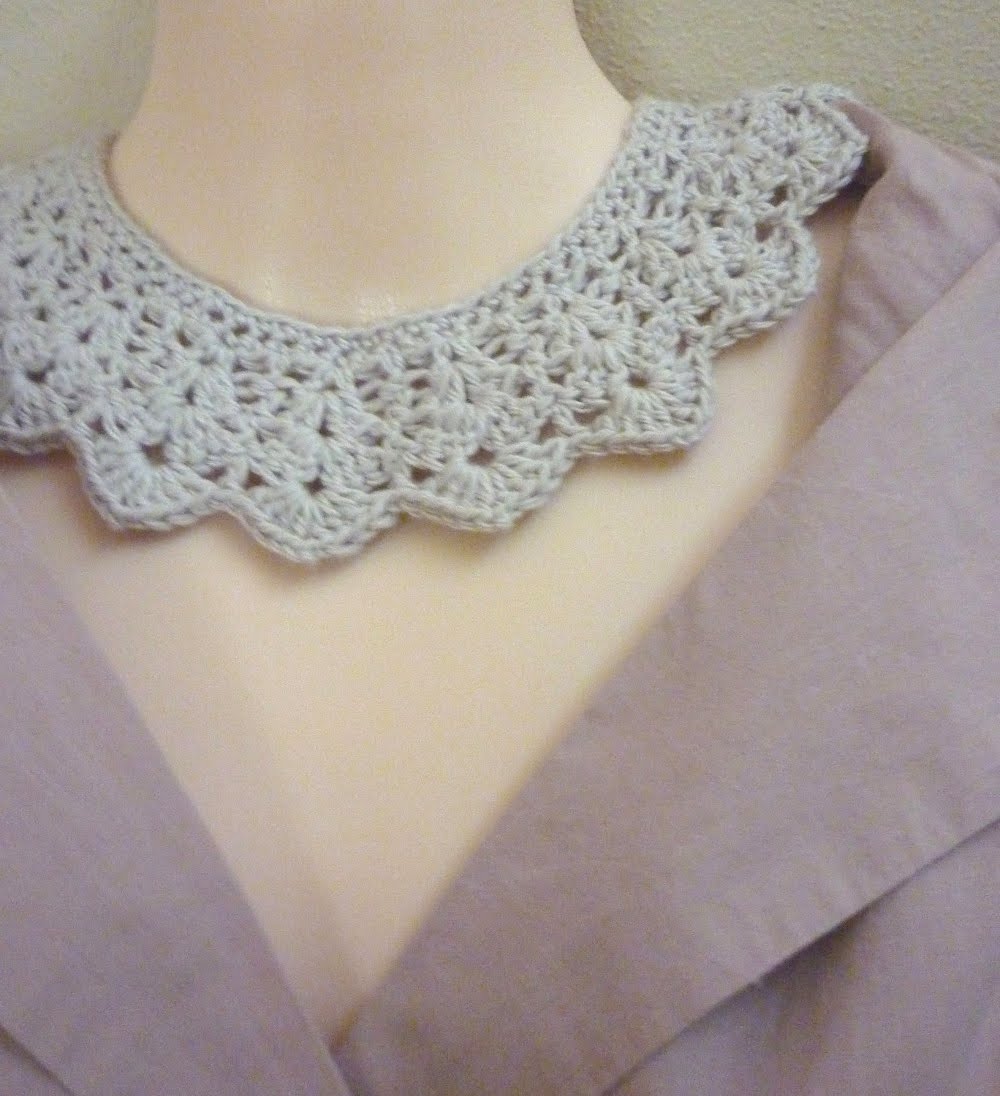
Not wishing to be caught idle over the Christmas break, I decided to forage about the internet for a crochet lace collar pattern - to make something for myself, for a change, and as research for Granny Funk's own soon-to-be-invented crochet collar design. Here's what I made:

You can find the pattern for this collar at The Ongoing Project blog - have a look at the beautiful deep pink they've used there. It's a nice one. I've worked mine in a thicker cotton than they recommend - Bendigo Woollen Mills 8ply cotton, creating a chunkier version. I've also used the pointed-edge variation of the pattern. I'm planning to design one of my own soon - probably with varying sizes of points/scallops.


Happy holidays!

x Granny Funk

Tuesday, December 14, 2010

With a little bitta funk, and a little bitta punk...


Here are some pics of a couple of neck-warmers I had ordered from me recently - the blue one from my stock and the orange and green as a commissioned piece. Perhaps not the season for wool around your neck - but good Christmas presents nonetheless.

Having little button-up neck-warmers appeals to me a lot personally as I tend to get a cold neck in winter but my general poor co-ordination makes a long scarf hanging down around my neck just one more hazard to negotiate. I started exploring button-up scarf creations a few months ago, and it's fun.

The blue scarf on the left is called "Industrial Children", and it's part of my Granny Punk range. I've enjoyed exploring a punk aesthetic, making use of both "pretty" things like lace and flowers together with skull beads, safety pins, and bits of junk like aluminium ring-pulls. I've tried to bring the punk aesthetic into conversation with my own aesthetic, which is substantially earthy. To some degree, a punk aesthetic involves re-appropriation of industrial objects not designed to be decorative, reinvesting them with new meanings - e.g. the safety pin (sociologists and pop culture theorists like to call this bricolage - a concept Michel de Certeau talks about in his book The Practice of Everyday Life).

As a would-be critic of industrial society, this renegade reclamation of industrial wares appeals to me. I like that industrial junk can be re-appropriated as beauty - there is a sense of resistance in that. My own hope is that we can move even further - not only re-appropriating as our own the pre-determined products of an industrial economy, but beginning to shape for ourselves the very forms of the things we produce. Incorporating junk bits into a handmade, earthy scarf is something of that to me - combining the creative abilities needed to make use - and beauty - of what we already have, with the visionary creativity needed to move toward something altogether different. I guess that's what "Industrial Children" is about - my hope for my own generation to re-imagine that which we already have and which has grown stale in our hands, and to prophetically imagine a future which is altogether different.

I'm happy she's found an owner! Here's another picture:

The second piece, you'll be relieved to hear, is invested with no meaning so profound. It's called "As Chance Would Have It", and it's about...green, and orange, and bright buttons, and I hope it's going make to make someone smile. To make up for the lack of profundity, I'll just swamp you with pictures:


x Granny Funk

Monday, November 8, 2010

Granny Funk and the Crochet Hook VS Miles and the Screwdriver


When I was a kid, my parents read us a story called Miles and the Screwdriver. It follows the antics of an obsessively inquisitive child named Miles who acquires a screwdriver and begins taking things apart, just to see how they work. It begins with a simple pencil sharpener and quickly escalates into screwdriver-crazed destruction, until Miles by some means unclear makes it to the north pole and the very big screw which holds the whole world together. He is interrupted at this point by God, who points out the obvious impending consequences but overall turns out to be a good sport and gives Miles a chance to atone for his sins through a goodly dose of the Protestant work ethic, repairing everything he has thus far disassembled. No minor task, since that included much of the known world (even as a kid I was skeptical about the importance of screws in so many major historical buildings, but my construction-adept father said nothing).

I recently found myself in somewhat the opposite position to Miles – trying to put something back together to see how it worked. I was repairing this beautiful crochet blanket.


It was the first time I have attempted a major repair on a piece of someone else's work, and an interesting experience since the ability to “read” stitches is pushed to a whole new level when you have a disintegrating tangle before you and have to work out how to rework sections that have unravelled and yet still have other stitches trying to attach themselves to whatever's left. I had assumed I would have to add in extra cotton, but didn't since what had unravelled had initially been enough.

It's interesting trying to puzzle out a construction technique that's different from the form of crochet I know. In the end my work was a good approximation but not the same method, since the original stitches seemed to be trebles with some kind of double-twist in them I couldn't explain (if anyone knows the name of this, let me know!).

It felt good to repair something so beautiful, and it made me reflect upon our tendency to throw things away rather than repair them. Despite a common assumption that materialism underpins consumer capitalism, the prolific generation of material objects – often of dubious quality – trains us to not value any one thing in particular, since everything is replaceable and in fact, consumerism depends upon our desire to replace what we have. Reconstructing another person's handiwork is a kind of participation in, and renewal of, a creative process started by someone else, a kind of passing of the baton of beauty. The labour of restoration says “This is beautiful, and it is enough”.

I'm unclear about the final moral of Miles and the Screwdriver. Certainly in my own family, the tendency to take things apart has always been linked to the the quest for understanding in order to repair and create. But certainly deconstruction is easier than repair or creation, on the moral and intellectual planes as well as the material one.

I hope whatever I choose to pull apart is eventually in the service of repair – repair of blankets and of human society. Post-industrial visionary that I am, though, I am uncomfortable with the idea that the world is held together by a screw. I would suggest instead a dovetail join, right in the centre of the earth.

Tuesday, October 26, 2010

One For The Track...


I recently enjoyed the pleasure of experiment in a commissioned work for a friend planning to walk the Bibbulmun track (yes, all of it, and for the second time). She wanted some arm warmers for the chilly mornings - green and foresty, with flecks of blue, invoking both the woodland and the ocean. Well, I thought that was a way to create a major colour clash, but I said nothing and pondered over the task, thinking how I might be able to separate the blues and forest greens with a certain smattering of brown and yellow. Here are the pictures of the finished object, which for the purposes of not getting too warm too quickly and thus avoiding a frustrating state of my-arms-are-cold-but-they're-too-hot-in-those-damn-things, I added a Goth-if-only-it-was-black style openwork lacing.

Now, with a happy customer safely meandering about the countryside, try to imagine them with suitable track-walking clothing and tell me, did I get away with it?

Love,

Granny Funk


Friday, October 15, 2010

Pimp Your Ride!

One of my favourite designs - of my own! - has been my crocheted bike seat covers. They are really fun to make, although they do take a little time, what with colour changes and directional changes for the underside (also counting is always a problem for me - don't tell my students).

They are also an exceptionally fun-come-embarrassing (depending on how socially engaging I'm feeling) project for crocheting on public transport, given their rather strange and suggestive shape and the complete lack of visual clues connecting it to a BICYCLE to the average fellow public-transport rider. This, however, is one social cost which I am happy to bear for the greater good of the dying arts, although not necessarily late at night in the drunken hour (mind you, even a pirate eye patch I was crocheting elicited some inappropriate gestures from a young boy, so either my designs are ravelling their way along a Freudian thread of which I am naively unaware, or the problem is in other people's minds).

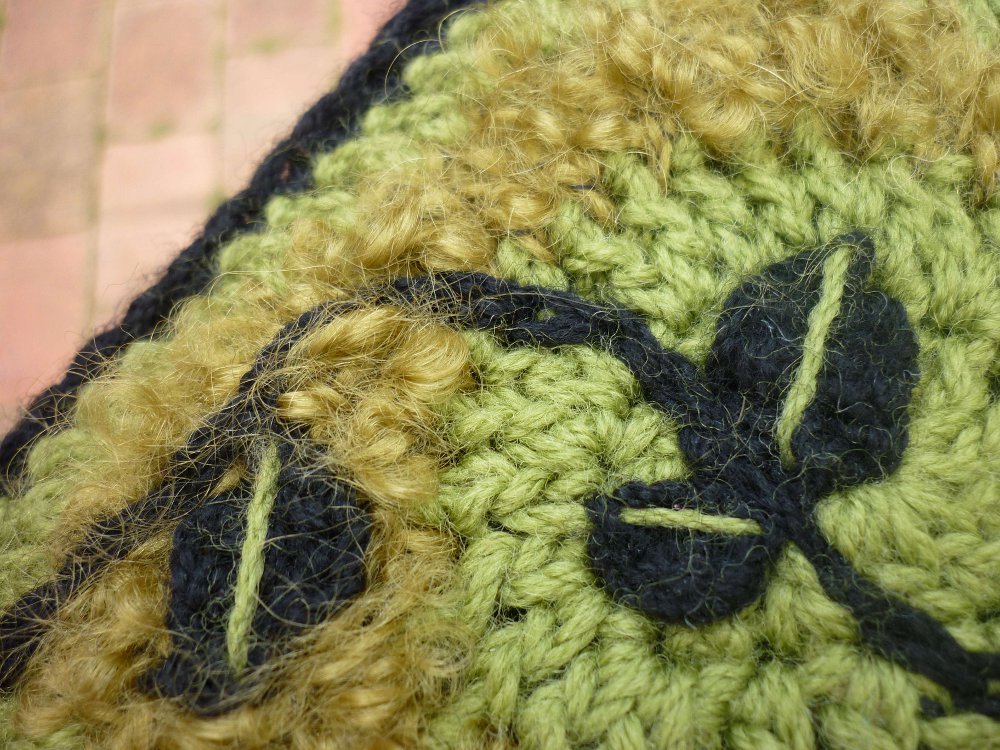
Here are some pictures of a commissioned bike seat cover I really enjoyed making recently, entitled "Envy's Vine". I was going with the poison ivy theme, only my inclination toward botany wouldn't let me call something with an un-ivy-shaped leaf ivy:


I'm going to be making a whole lot more of these in the coming month as I gear up for my stall at the Made On The Left Christmas Market on Saturday the 13th November. With the weather warming up and the threat of being rained off your bike diminishing, it's a good time to dress up your bike.

I like to think this simple beautification of the bicycle goes some way toward promoting the bicycle as a dignified transport option*. If your bike is your friend, or if it's been rusting in the tin shed all winter and is crying out for some attention, consider commissioning a special bike seat cover for it - or for someone else's bike.

Crocheters, keep an eye out for the pattern too - soon to be available as a pdf from Granny Funk's Etsy page.

* For those who don't see crochet as inherently dignifying, well...I'll admit you've got some evidence in your favour. HERE for example.

Wednesday, September 8, 2010

Beanies for Woodworkers


I've recently begun learning to work with wood at the Australian School of Fine Wood and have a new appreciation for my army jumper pencil pockets. It is very easy to mislay things at the best of times, and having your pencil attached to your arm is handy. As a tribute to the beautiful surrounds of the Forest Heritage Centre, and in honour of woodworkers and their noble craft, I decided to launch a new range of Forest Heritage Beanies for woodworkers.

As everyone knows, behind-ears are also great places to keep pencils. But if your ears get cold and you need a beanie, it seems unfair that a woodworker should be doomed to pencil misplacement (in the absence of a good army jumper, that is).

Here's an example of the new range that I'm proud of - I've adapted the pencil pocket idea to suit a beanie and I think I've solved the trade-off between cold ears and wandering pencils. If you're ever down in Dwellingup, drop into the beautiful Forest Heritage Centre, check out the designer-maker furniture in the gallery and keep an eye out for Granny Funk's range coming soon to the gift shop!

Thursday, August 12, 2010

Crochet Me An Ocean


I thought I'd post a commissioned work I made recently for a surfing friend - partly because it brought me a lot of joy and partly to show how versatile crochet can be. This piece was designed around an ocean theme - I tried to capture the sand, surf and the bright underwater treasures of coral. Commissioned pieces are really fun - I like playing around with a theme and trying to work out how I could capture it with yarn.

Designed originally as a button-up neck scarf for the chilly coastal winds, this piece quickly moved upwards to my friend's head as a wide head band - where, quite honestly, it looked even better. I really enjoy the design process of tailor-made items, especially where it's for someone I know. Matching a piece to a theme and also to a person is a skill that takes a combination of logical thought, intuition, and creativity. I had initially planned to add bottle-tops and "ocean junk" to make the piece a commentary on both marine beauty and ecological degradation, but the piece felt finished before the junk made it in so I decided to curb my activist bent. It was enough to make a piece that was a tribute to the beauty of the ocean in itself.
Speaking of tributes to the ocean, the friend who commissioned this piece has taken some beautiful underwater photos which you can find here.